Emperor Christian Victor I

Emperor Christian Victor I
Showing posts with label 1996 Revolution. Show all posts

Monday, 23 March 2015

Memory Monday (The Throne of the United Empire of Scot-Britania)

The discovery in 2014 of the walled up secret vault in Reichenthal was a pleasant surprise of international value. Amongst the many historic and intrinsic treasures was the Imperial Throne of the United Empire of Scot-Britania that was thought destroyed during the 1996 Revolution. However a twist of fate lead to it being saved and secretly stored in Reichenthal. Today we will feature the history of this cultural artifact which has already been featured in several official portraits and events since its return to the Cathedral of the Lionheart.

Here we see the throne as it was found inside the hidden vault. Historians suppose that the throne was in Riechenthal at the time of the revolution for general maintenance. As the revolution gained momentum it must have been hidden to try and save it from destruction due to its political symbolism. Thus it and many other historic treasures were spared the ravages of the revolution and ensuing civil war in Syldavia.

Ironically the very region that saved the throne, Reichenthal, was also responsible for its creation. It was commissioned in 1992 in advance of the establishment of what was to be the United Empire of Scot-Britania. Reichenthal artisans and craftsman are world renowned and for centuries have supplied the courts of Europa with carriages, furniture, art and wine. For the Imperial coronation that officially established the new Empire a new throne was needed. It was to symbolize the unification of the two separate Kingdoms of Scotney and Britania into one Empire. 

The original design sketch for the throne survived in the Reichenthal archives to this day. Here we clearly see the cathedral like concept design that is to imbue a spiritual air to what was to be a symbol of unity and aspiration. The style was deliberately chosen to look medieval whilst being a modern throne to also link the past to the present.

The Three Headed Eagle of the Imperial House of Aldarian shown here on the Imperial flag was included on the back rest of the throne as symbol of the supreme authority of the Aldarian Imperial Family. 


The individual ancient thrones of the Kingdom of Britania (left) and Scotney (right) were symbolically dismantled to show the dissolution of the two separate Kindoms. The wood was then combined with new Oak in the manufacture of the new throne in order to join the two thrones and nations symbolically into one. 

The restored throne as it is today after its rediscovery in Reichenthal finds itself in its old home, the Chapel of the King in the Cathedral of the Lion Heart. It was intended originally that the throne would be permanently housed and displayed there for the public only to be taken out  for coronations of which the combined coronation of Emperor Christian and Empress Crystobel was the first and only. The cathedral is open to the public at set times and as such the throne can again be seen there on display.

The world is truly glad that this icon of Europan history survived the 1996 Revolution and can again be appreciated by the public and serve as a testament of our collective past and the lessons learnt. 

Tuesday, 17 February 2015

Breaking News (Crown Fragments)

The world is agasp at the news of the most historically famous crown returning from what was considered to be its factual destruction during the 1996 Bloody Revolution. The Crown of St. Christian, has a legendary origin and has long symbolized the monarchy and more poignantly, the independence of Scotney. It does however have some controversial connotations as it is seen by some historical and political commentaries as the Crown of both the Kingdoms of Scotney and Britania. Regardless of all this, the Crown was one of the objects reported destroyed by the revolutionary governments after the 1996 tragedies. 

The Proclaimer was on the ball this morning reporting on the very mysterious return of the Crown and showing an archive photo. Some saw this shocking news as a hoax but investigation into the matter is seemingly proving the Crown's authenticity. If the Crown proves to be original it may be seen as a sign from God or good portent by many of the older more superstitious generation in Scotney and Britania. This may force an official response from both countries' leaders as to how to handle the matter inclusive of the Crown Prince Imperial's very new and tenuous return to the Islands of Scot-Britania.

The famous Cathedral of the Lionheart has been the venue for many historic events such as coronations and funerals but now it seems a kind of miracle has also taken place with the mysterious return of the Crown of St. Christian. 

The Blue Cardinal was the one who found  the strange deposit upon the high altar of the cathedral yesterday morning. His Eminence is in the habit of walking while praying through the cathedral very early each morning but then yesterday he spotted something out of place gleaming on the altar. It turned out to be the solid gold Crown of  St. Christian cut into neat fragments and a small vinyl case filled with precious stones. 

The relic Crown of St Christian is imbued with myth and history and many who support the traditional concept of monarchy might see its miraculous return as some kind of "Word of God" or blessing upon the Crown Prince Imperial. This poses a political stress as it may birth sentiments of a restoration in full of the monarchies of Scotney and Britania and perhaps even the very controversial United Empire of Scot Britania. 

This photo shows the fragments and gems as they were found. One can easily compare the design of the fragments with the archive photo of the original Crown below. Such a close comparison reveals the obvious similarities but did at first not exclude the fragments from being modern copies. Closer inspection was needed. 

When the fragments are compared to this archive photo of the original crown it is clear even to the untrained eye that the fragments look like the photo. Experts were called in to do a proper analysis. 

The world renowned expert on antique jewellery and aunt of the the Crown Prince Imperial was the obvious choice to inspect the Crown fragments and gems. She was joined by her nephew and the Blue Cardinal and our news cameras. 

It is easy for a scholar of the jewellery manufacture discipline to assess the age of a piece of jewellery by virtue of styles and technique in metal work and stone cutting. Modern tools also leave distinctive marking proving that a supposed antique is actually a modern forgery. However, the Crown fragments passed all tests and analysis proving it to be the original. There was also evidence found that some gold was lost to filing away and not all the gems documented to be in the original crown were present in the case. T

The Crown Prince Imperial, the peoples of Scotney and Britanania and their governments are all, regardless of controversy, very happy that this important piece of history has in fact been preserved. The Crown Prince Imperial has committed to have the Crown be restored to its former glory at His Imperial Highness' own expense. He also then from the onset, vows that the Crown will remain part of the Imperial Crown Jewels Collection held in trust by himself for both the nations of Scotney and Britania in perpetuity. Not unexpectedly, many calls have come from the public sector in both Scotney and Britania for a restoration of the monarchy but the political opinion remains divided. If the public sentiment continues a referendum may be called to settle the matter once and for all. For now however, we will focus on this happy find and look forward to the Crown's full restoration. 

Monday, 2 February 2015

Memory Monday (Europan Kingdoms through the Last Century)

Some of our greatest supporting fans have asked for a bit more on the literal geography of the Kingdoms of Europa and although we have posted maps and discussed it before we thought to devote this post to the topic. Europa is a continent generally thought of as the center of the world and the origin of modern civilization. In past ages many small regional Kingdoms have come and gone but also a few vast Empires saw the light. War, natural geography and economy have given us what we have today, a rich mix of history, culture and natural diversity. Let us look at the various regions and peoples over the last century and the nations that ended up in what we have today. 

Pre 1900 (Great War) - Empires

At the turn of the previous century Europa was experiencing an economic and technological boom. Cuturally though the apex was seemingly reached and a new beginning was looming. Few would expect war to be the ushering in factor that lead to change. There were several well established Kingdoms ranging in size and history but soon the Germanic peoples of Syldavia started bold expanding what they claimed to be their right. This was in reaction to the vast power of Ruskiana which was felt to be a bully of its own people and the western nations of Europa. The newly established Germanic Empire did overstep its right and soon war broke out. The predominant powers were Ruskiana, the Germanic Empire and the Scot-Britanian Alliance. After the devastation, the map was entirely redrawn setting the stage for a new beginning and eventual golden age. 

Count Otto Von Bismarck, Chancellor of the Germanic Empire and the spark that set the fire of war ablaze. 

The last Tsar of Ruskiana who lost his own life fleeing the country. 

The Duke of Swann toured Europa on an last official diplomatic tour before the Great War broke out. He used this opportunity to assist his Royal relatives in smuggling many war threatened historic treasures to safety in Hanoveria and Reichenthal. 

After the Great War, the map of Europa didn't just change borders but also changed the the states of nations literally. Ruskiana and Romagna abolished their monarchies and the Germanic Empire was split into several smaller independent Kingdoms. However over time Scotney and Britania were to merge into a single Empire which included the former Duchy of Lancaster and Swann as semi-independent states. Two very small tax haven independent countries also saw the light in Monagask and Rosenberg.

Pre - 1996 Revolution Golden Age Europa

The Predominant power of this era was the short lived but unimaginably glorious United Empire of Scot-Britanian. Many saw this as a dawn of a new era for the whole world but the threat of one nation holding so much power sparked the most tragic and most murderous revolution the world has ever seen. 

Scotney and Britania amalgamated into a single Empire under the joint regents Emperor Christian and Empress Crystobel, seen here on their wedding day. 

This rare photo shows the Imperial Couple dressed in formal tiara and tie on the very night the Bloody Revolution broke out. Much of the historic archive was destroyed by the revolution leaving photos like this an extreme rarity. 

The last State Visit of the Duke of Swann to the Empire of Scot-Britania. The Empress'sister was married to the Duke of Swann and her youngest sister to the Grand Duke of Hanoveria. Several other close family ties bound the Imperial couple to most of the Royal Families of Europa.

The greatest damage to monarchy as a concept came with the 1996 revolution after which only 5 of the original 12 monarchies that reigned 200 years earlier remained. This brings us to today almost 20 years after the Bloody Revolution.

Post 2012 (Normandian and Syldavian Restorations) - Current Europa

Europa sees no predominant power amongst it many countries allowing for balance and a strong economic and cultural stability like never seen since the days of the Holy Emperor in 1277. The two monarchies of Normandia and Syldavia, abolished during the revolution, have been completely restored and the idea of Royalty is riding high in the media and popular opinion. This pushes the total of monarchies in Europa up to 7. 

Royal exiles have also been welcomed back into Ruskiana, Romagna, Scotney and Britania. Pretenders to former thrones in these countries are offered semi official cultural positions representing the "people and histories"of their countries. These roles are akin to that of an ambassador and/or minister of culture without having any political power whatsoever. These positions also do not gain money personally but is allowed a budgeted expenditure in lieu of playing the role of custodian of property, art and jewels held in trust for the nation. In Fulco D'Este and Franconia the former Royal Families are not regarded in a bad light but are also not seen as more than novelties even though all exile laws have been made void. 

The 2012 Christmas Ball saw the largest gathering of Royals since before the 1996 Revolution and also finally welcomed Arcwhite completely into the Europan Royal fold. 

The tragic death and funeral of Empress Crystobel rallied the emotional support of the whole world around the Crown Prince Imperial boosting Royal popularity to the highest in history. 


Last year's birthday Ball reestablished the Royal momentum after the tragedies of 2013 allowing us all to look to a bright new and seemingly very solid Royal future in Europa. 

Hopefully this post has given a bird's eye-view to our more technically minded fans. 

Tuesday, 4 November 2014

Breaking News (Arcwhite Breaking Point)

Relevant government heads met yesterday in the Switzer Federation for an emergency meeting surrounding the Arcwhite crisis. The purpose of the meeting was to hear and assess all the evidence gathered from Lady Arcwhite, combined with that received from the executed assassin of Empress Crystobel and the apprehended bombers of the Serbieski power plant. It has been rumoured for years that an underground terrorist group has been working in Europa since the days of the 96 Revolution. Evidence of their existence had been obvious from their very overt actions but who they were and their specific agenda has been unclear. In recent months evidence that links the power plant bombing and the theft of the Duke of Swann's emeralds were proven but since the confession of Empress Crystobel's assassin far more has come to light linking even the 96 Revolution to all these tragedies. Investigations continued as more proof was needed before decisive action could be taken. The council now brings Lady Arcwhite's surprising confession into the mix with the intent on rendering final judgment and to set in motion a plan to eradicate the terrorism that has plagued Europa.

Lady Arcwhite's written statement begins with her motivation for fleeing Arcwhite as being an attempt at averting another war. She made the radical decision to desert her government and disclose all her knowledge of the Order of the Veil's secret and classified activities that she was privy to. These allegations many, verifiable and some still not entirely proven, reach as far back as the Franconian Revolution  centuries ago and have answered many of the mysteries surrounding what sparked the 96 Revolution in the former Empire of Scot-Britania. As far as facts go, the Order of the Veil may as well be one and the same as the underground terrorist group.

The Europan Emergency Council gathers in the Switzer Federation as a department of the Europan Government Union. Not all members were physically present but were in communication by phone and ready to vote on the matters in hand. Member nations physically present were from clockwise top left; Syldavia, Wallachia, Swann, Hispania, the Foreign Coalition, Ruskiana, Britania, Scotney and Romagna. All members were represented by their actual heads of government or heads of state or both, lending a sense of seriousness to the meeting. The foreign coalition is an observing body representing nations from outside Europa but is afforded a voice in Europan concerns. It was represented by Queen Ukulunghile from Ophiri.

His Imperial Highness, the Crown Prince Imperial was elected acting Chairman of this Emergency Council due to his intimate involvement in the matters but political neutrality.

The council convenes, opened by its Chairman.

The Duke of Swann presents the case and testimonial evidence of Lady Arcwhite to the council and media. The list of alleged atrocities committed by the Order of the Veil as an organization and its members is as follows:
1. Financing the Franconian Revolutionary Interim Government before their legitimacy was established.
2. Using extortionary tactics to manipulate the D'Rothchild Baronial Family and its Banking network for the purposes of destabilizing economies and governments which in particular had huge impact on the events leading to the Great War.
3. Having agents in Ruskiana that were directly involved in the death of the Imperial Family of Ruskiana in the onset of the Great War.
4. The theft and secret concealing of the Serbieski Crown Jewels with political intent.
5. The assassination of  King Rishard Joshia of Reichenthal.
6. Having agents within the Scot-Britanian Government with the intent on causing distension, affecting the economy and spreading tactical misinformation.
7. Having agents in the Scot-Britanian Airforce that fired the missiles into Roswind Castle sparking the 1996 Revolution.
8. Financing and strategically directing the Europan Mafia with the intent on extorting major Europan Government officials.
9. Establishing a Serbieski underground under false "patriotic" sentiments to destabilize the Syldavian Governement and smear the reputation of the Serbieski people to further these separatist intents.
10. Using the fabricated persona of "Sable Blackwood" as an agent to establish money laundering businesses in the Principality of Swann and to gain intimate relational access to the Duke of Swann.
11. Stealing and destroying the historic emerald collection of the Duke of Swann to divert attention from themselves and to focus it on a possible Serbieski underground terrorist group.
12. Bombing their own power plant in Serbieski to further develop the case for a supposed Serbieski underground with separatist patriotism as aim.
13. Hiring a Serbieski hit man to successfully assassinate the Empress Crystobel to halt Royal popularity and to further establish Serbieski as a problem region.
14. Conspiring with current the Baron D'Rothchild in finally using his influence to break the Serbieski regional economy, followed by a staged Sykdavian assassination of the Grand Duke with the result of  casting the entire Europa into another war.

The Chancellor of Britania, one of the vetoing members of the council and representative of the most powerful military nation in the Europan Governement Union, rendered the final judgement directly to the world media. He stated that the Mother of the White Veil and the entire Order of the Veil was not recognized as the legal government of Arcwhite. The Mother of the Veil, for her usurpation and the allegations made by Lady Arcwhite, was an international criminal and just so, all those that sided with her. He issued the immediate arrest of the Baron D'Rothchild for conspiracy, treachery and money laundering. The Baron's confession would also lead to finalizing any as yet unproven facts in the allegations of Lady Arcwhite. However, Lady Arcwhite's case provided enough proof for the council in representation of the entire Europa to declare war on the Order of the Veil. This left the nation of Arcwhite with 2 options; to side with their current criminal government, preparing to defend their country or to deliver up this false government alive or dead to stand account for their actions.

The Duke of Swann was commissioned to gather a team and join with the Mithrandir in order to respond to the Arcwhite's final decision.

The Baroness D'Rothchild, wife of the now fugative Baron, is reported to have fled to her brother the Grand Duke of Serbieski. She is being interrogated in the investigation of her husband's whereabouts.

We await the official response from Arcwhite and for news on the Baron D'Rothchild.

Wednesday, 8 October 2014

Breaking News (Serbieski Power Plant Bombers Apprehended)

Shocking revelations have come to the fore and are going viral as we speak around the globe. The confessions of Frantisek Voorheest to the Mithrandir just before his execution a week ago has led to the arrest of the bombers of the Arc International Power Station in Serbieski. The bombing that took place in March 2013 caused severe tensions in the politically precarious region on the Wallachian border of Syldavia. Political dissidents have plagues that region and indeed the Syldavian stability since the 1997 Syldavian civil war that resulted from the Bloody Revolution in Scot-Britania. Intense investigations into the bombing brought forth very little evidence but suspicions have now been confirmed by Mr. Voorheest's confession.  

The Arc International Power Plant is a constant controversy in its own right as it has brought much needed power and infrastructure to an impoverished region of Serbieski. However its impact on the surrounding natural environment and its groundbreaking technology still raises many serious concerns. 


The bombing was at first believed to have been motivated by fanatic environmentalist but was soon proven to rather be motivated by political dissidents with strong anti-monarchist agendas. Serbieski has a very deeply ingrained nationalist history and its mediatized inclusion in the greater Syldavia remains difficult to this day. The return in Septemeber this year of the Serbieski Crown Jewels however has placated the region's proud people.

Frantisek Voorheest, the executed assassin that killed Empress Crystobel in 2013 on her official visit to Britania admitted to the Mithrandir minutes before his beheading that he was part of an underground political move bent on eradicating all form of monarchy in Europa. He shared information about the bombing in Serbieski that only an insider could know adding lost puzzle pieces to the investigation.


This information has lead to the arrest of a several people linked to the bombing and proves that it was financed by the theft of the Duke of Swann's emeralds as was also suspected. There statements also now add even more evidence to the mix. A golden thread can now be drawn from the theft of the emeralds to the bombing and assassination of the Empress. This has obviously also led to a few new questions and implicates a few new suspects. However much of this is still classified as it seems more has been uncovered than the authorities could have imagined and if links to the 1996 Revolution are implied then this has international repercussions on the level of war.

Wednesday, 10 September 2014

"To be or not to be" Thursday (Three Sisters)

It has been just over a year since my aunt, Empress Crystobel's assassination. I find myself recently missing the "good old days", missing her. By extension I miss my own mother, her sister. Family really is such a foundational part of life.

Our story of Royalty essentially revolves around 3 foundational characters. These three cousins; the Crown Prince Imperial, The Duke of Swann and the Grand Duke of Hanoveria, are the first born sons of three Princesses. These three sisters, who all ended up seated on thrones were very close and due to their efforts and sacrifices, Royalty survived past the 96 Revolution and into the new millennium. Today's post aims to remember these three sisters and their place in our history.

Here we see from left; Princess Beatrice, Dowager Grand Duchess of Hanoveria, the late Empress Crystobel and the late Duchess of Swann. They are portrayed here in a photo taken in the very year the 96 Revolution took place. Serene smiles seek to banish the growing tensions of the period and glamorous historic jewellery combine with glorious gowns in an attempt to persevere through hardship. Empress Crystobel was much liked even up until the outbreak of the Revolution. many mysteries still surround the actual causes of it. Princess Beatrice was happily married in her very peaceful new country of Hanoveria but was to lose her husband to the assassin's bullet of a blackmailing crime cartel. The Duchess of Swann was the only one of the three sisters to have actually passed away in the missile strike on Roswind Castle that sparked the 96 Revolution. The appalling death of many visiting foreign dignitaries that night almost cast the whole of Europa into war. 

The only surviving sister seen above is Her Royal Highness Princess Beatrice, the Dowager Grand Duchess of Hanoveria, Princess of Scot-Britania and Princess of Scotney. She, the youngest of the three siblings, battled cancer successfully a few years ago and now lives in secluded retirement after her years of devoted service to her family and adopted country of Hanoveria. 

The three sisters were born Princesses of the Kingdom of Scotney and with their eldest sister Crystobel becoming Queen of Scotney and eventually Empress of a United Empire of Scot-Briitania were all elevated to the rank of Imperial Princess. Princess Elizabeth of Scotney was the middle daughter who went on to marry the Duke of Swann amidst a media extravaganza. The popular couple were lauded in the Principality of Swann that boosted the small country into the media bull's eye where it has stayed since then. The new Duchess of Swann was the most popular Royal in the most popular monarchy in Europa and she excelled in her position doing more for charity, art and fashion than any other Princess before her. Unfortunately she was killed in her prime and the empty space left by her on the consort's throne of Swann has never again been filled. 

Probably no other Royal has received more coverage on this blog than Empress Crystobel. Her life and character has become a veritable archetype and icon of womanhood. The combination of strength and sensitivity, invincible endurance and her indelible grace even in the face of tragic loss and death will live on forever in and thoughts and hearts. She was born a Princess, inherited the title of Queen and became a wife and Empress. Her role as mother and business woman to boot is the icing on the cake. Unwavering style and humility is testified of by all who met her and the dedication shown through her life and work and perhaps even just her portrait has inspired in many. 

A previously unpublished photo sees the three sisters in 1995 celebrating the birthday of Princess Beatrice. The two younger siblings wear matching necklaces given them by Empress Crystobel of which Beatrice received hers that very day.

It truly is amazing the consequences and extenuating results a mere sibling relationship can have on the very world. For good or for bad, how we treat those around us does ripple on into eternity. let us follow good examples and learn to love our neighbour that we may affect the world like true Royalty. 


Monday, 11 August 2014

Memory Monday (The Reichenthal Secret Vault)

 Apart from the return of the Crown Prince Imperial to Scotney and Britania (to be reported in detail next week), the most exciting news to happen over the last month or so was the very unexpected discovery of a secret, walled up room in the Castle of Reichenthal. This entirely unknown room was a surprise even to the Grand Duke of Reichenthal who grew up in the castle. The story has since gone viral as upon breaking open the room it revealed the largest single historic treasure ever documented. In today's post we finally report on this most dazzling story. 

It was early June in the small province of Reichenthal in the Kingdom of Syldavia.

The "magical" Castle of Reichenthal, official residence to the Elector Grand Duke Lothair and his family, was unexpectedly going to reveal what has become the most spectacular discovery of our age in the form of a treasure horde thought lost to history forever. Little did this peaceful and almost quaint region expect to be the epicenter of such a internationally pivotal twist in history. 

The Castle of Reichenthal is a veritable maze of halls, rooms, corridors and even secret passages and hidden vaults. It is also a very old castle with some parts dating back to over a 1000 years. It is understandable that maintenance and repairs pose a huge challenge as even plans of the castle are for some parts at best, speculation. Thus in a less used part of the castle a maintenance worker doing routine sonar scans  following plumbing in need of repair unexpectedly discovered a hidden walled up room. Upon the Grand Duke's orders the wall was breached to reveal an unimaginable treasure.

For the sake of historic account and possible legal logistics, the Grand Duke wisely called in an expert to witness the entering of the room and to also take meticulous account of its content, its value and historical connections. Princess Augusta, high profile Royal and world renowned antiques dealer was the perfect lady for the job and jumped to the opportunity to assist. 

The Grand Duke, as owner of the castle and legal custodian of the discovery under international law was the first to enter the room through the wall. 

Upon first glance it is clear that the treasure is of immense size and intrinsic value but far more important historical value. It seemed by virtue of the hasty masonry and some of the immediately recognizable artifacts that the treasure was stored during the time of the outbreak of the 96 Revolution in order to protect some of the artistic and historic treasures of Europa and even to hide some of the politically volatile pieces. Reichenthal has for centuries been the artisan capital of Europa and has been responsible over generations for the manufacture and repair of many of its historic artwork. As such at any given time pieces in the process of manufacture or maintenance was present in the Reichenthal workshops and during the advent of the Revolution may have been transported to safety in order to protect them from revolutionary destruction. This seems to be the case in point of this room and also the fact of its secrecy. Over a generation all memory was lost and it seems to be the fortune of this generation to have discovered it again.

One of the main features in the room is the solid oak throne with the very obvious insignia of the Three Headed Eagle of the United Empire of Scot-Britania. The throne was especially made for the coronation of Emperor Christian and Empress Crystobel in 1993 and must have been back in Reichenthal for basic maintenance at the time of the revolution. It is a discovery of vast historical impact and serves to accurately prove when the treasure room was sealed. An artifact such as the throne was at extreme risk of destruction during the time of the revolution in Scot-Britania and the consecutive civil war in Syldavia.  

It is clear from the state of the room that its content was hastily stored and walled in. Some chests were not even closed and reveals solid gold bullion and jewellery. 

This particular crown was recognized by the Grand Duke from his history lessons as being from the Reichenthalian Crown Jewel Collection and was thought lost during the Syldavian civil war that was sparked by the 96 Revolution. 

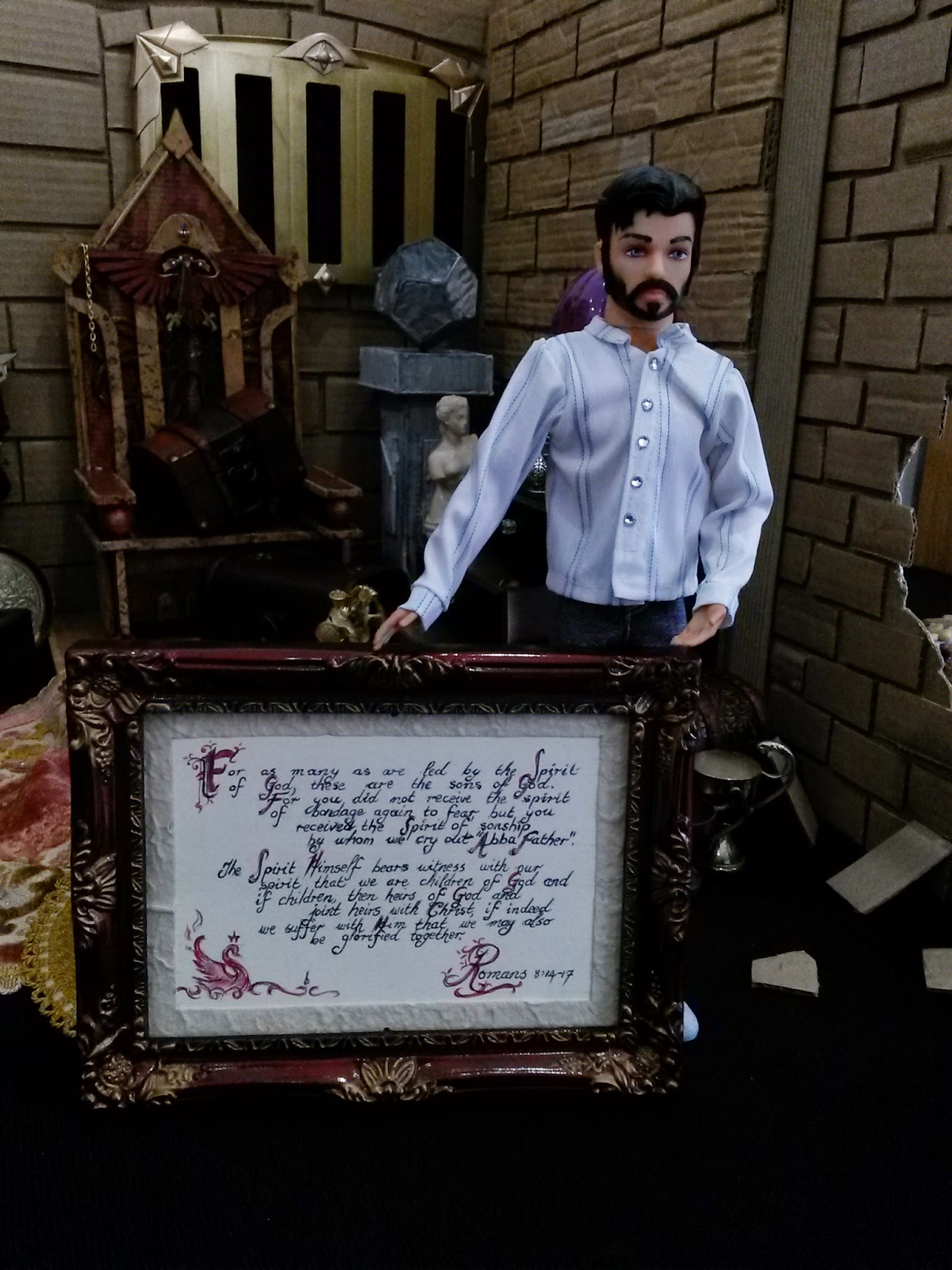
The room also contained art work such as this illuminated manuscript in calligraphy seemingly meant for the Duke of Swann.

A very large statuette of a peacock emblazoned with Venetian glass rhinestones stands as testament of Reichenthalian artwork at its finest. 

One of the many chests revealed a lapidary masterpiece in the form of a crystal swan. 

The swan being the symbol of the Dukes of Swann and a document of its commission and payment proves it as being the property of Swann and thus will be returned to its owner. 

A big part of the treasure is tantamount to bullion in the form of solid silver cutlery and goblets of no particular artistic or historic value. 

Vast amounts of solid silver plate and gold plate along with some rare Chinois crockery can be seen gathered together in this photo. 

The chests filled with jewellery are gathered for proper accounting and separate documentation and their content will be reported in a Tiara and Trinkets Tuesday of its own. 

This close up photo of the most historic and controversial part of the treasure, the Imperial Throne of Scot-Britania shows the awesome craftsmanship. It also raises the question of its now surely appreciated return to its homeland amidst all the current developments surrounding Royal popularity in Britania and Scotney.


The discovery of the treasure room and all its content is very exciting and seems to be provedence as a lost era is reconstructed before our eyes. Every single object is impossible to record on this blog but the jewellery will be documented. Other pieces of note will obviously be mentioned if and when they feature in future posts. We hope all our Royal fans enjoyed this post as much as we did here in the Duke of Swann's media office.